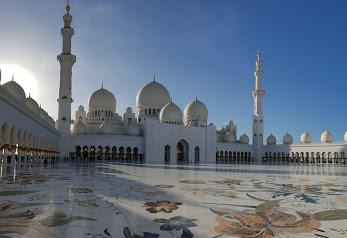
 Abu Dhabi, the capital of the United Arab Emirates, sits off the mainland on an island in the Persian (Arabian) Gulf. Its focus on oil exports and commerce is reflected by the skyline’s modern towers and shopping centres such as Abu Dhabi and Marina malls.
The United Arab Emirates is the constitutional federation of seven emirates: Abu Dhabi, Dubai, Sharjah, Ajman, Umm Al-Quwain, Ras Al Khaimah, and Al Fujairah. It stretched over 1448 km from the west coast of Persian Gulf and Gulf of Oman, where water and land overlap, to the Arabian Peninsula.
Education System in Abu Dhabi
The Department of Education and Knowledge (ADEK) - (previously known as Abu Dhabi Education Council) was established in accordance with law No. 24 of 2005, issued by His Highness Sheikh Khalifa Bin Zayed Al-Nahyan, the UAE President, the Supreme Commander of the Armed Forces and the Ruler of Abu Dhabi
The Abu Dhabi Education Council believes that all children can learn and that the responsibility for educating all students to their fullest potential rests with school staff working within a supportive educational environment. There are currently around 185 private schools in Abu Dhabi. Teaching in the Emirate of Abu Dhabi is extremely rewarding and exciting.
ADEK sees teachers as playing a vital role to school and student success. The vision of ADEK is to produce world class learners who are partners in the plan to create a world class education system.
ADEK Mission is to produce world-class learners who embody a strong sense of culture and heritage and are prepared to meet global challenge.
Teaching in Abu Dhabi is a unique and rewarding experience. It is an incredible opportunity for Educators. As a teacher, you play a crucial role in the overall development of the UAE empowering students with the skills and knowledge they will use throughout their lives.
Curriculum
The National Curriculum of England (also commonly referred to as the “UK Curriculum”) is delivered in most UAE British Schools. Programme which is a curriculum framework designed for students aged 3 to 12. As well as the above curriculum it is compulsory that children participate in Islamic and Arabic lessonsdelivered by fully qualified and highly trained Arabic teachers.
Language
Although Arabic is the official language, English is used as a second language which is excellent for westerners who do not know Arabic.
Dress code
All teachers working in UAE should dress professionally while at work. You are allowed to wear trousers (not tight fitted) skirts below the knee and blouse/tops that should be loosely fitted and not low cut. Jeans, shorts, and flip flop sandals are not permitted at work. Outside of work, teachers are free to wear whatever they would like, but it is recommended that all teachers are conscious of and respect the fact that the UAE is a Muslim country.
Religion in Abu Dhabi
Freedom of religion is provided for by the Constitution of the UAE, although Islam is the official religion of the country. Abu Dhabi has many churches, temples, and mosques, where
teachers are free to practice their respective faiths. The UAE is a Muslim country and because of this it observes the month long ritual of fasting during the holy month of Ramadan. During Ramadan, Muslims abstain from eating and drinking during the daylight hours. Ramadan makes a huge impact on life here in the UAE. School times are shortened, many restaurants remain closed during the day and alcohol is not served in restaurants during this month. While these may seem like major changes, they only last for a short period of
time and most people enjoy the fact that they can go home early even if they don’t observe the holiday! As if these timings weren’t great enough, Ramadan ends with the holiday of Eid al Fitr during which everyone gets at least 3 days off from work.
Women in the UAE
The UAE is a very safe country, and single women should not have any problems. As with any country, however, women should practice common safety procedures. Women are not encouraged to walk
alone late at night, or to attend gatherings alone with groups unknown to them. The UAE is unique in the sense that expats make up the majority of the population. Locals only comprise of less than 20% of the population which means that everyone else is international. This makes for a unique, cosmopolitan community that lends itself to a blend of cultures, customs and traditions. Because the population of the UAE is so international, it makes it easy for people to learn about new cultures and break stereotypes that they may have erroneously held about people of certain nationalities. The UAE provides the opportunity to make an international group of friends who can teach you many unique and interesting things that you couldn’t learn anywhere else.
Qualifications
In order to practise a teaching profession in the UAE, you must have a minimum qualification of a bachelor's degree in the required field. This rule applies for public/government schools as well as private schools in the UAE
Attested certificates
A background check and attested documents must be provided to apply for a work permit in the UAE. This is a requirment for all schools. Educate Abroad will assist candidates in the process of attestation. You will need to get your document notarized by a local notary.
Examples of documents you may need to get attested are:
- Your university degree(s
- Your background check
Once your documents are attested, you will need to send scans of these documents to your employer, and they will apply for your work permit. It's important to tell them which UAE consulate you will use to apply for your work visa, as YOU CANNOT CHANGE THIS LATER. So if you plan to use an agent, you may want to consult them at this point. The entire process can take anywhere from 3 to 6 weeks, so do not delay.
Do not worry Educate Abroad will assist you in all aspects of visa, work permit and document requirements. We will continue to support you from the moment you get in touch until you are settled in your new position.